Login
Login

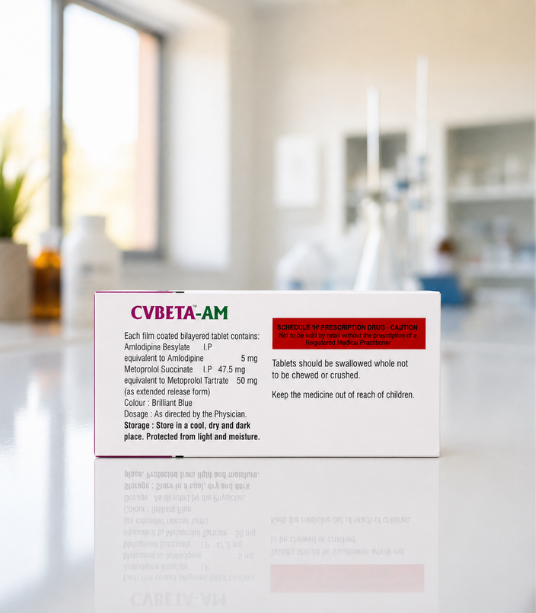




CV Beta AM
The combination of CV BETA AM ( Metoprolol Succinate ER 50mg and Amlodipine 5mg ) is a powerful dual-mechanism cardiovascular therapy. It combines a Cardioselective Beta-Blocker with a Calcium Channel Blocker (CCB).
This specific pairing is highly effective because it treats hypertension and chest pain (angina) by simultaneously slowing the “engine” (the heart) and widening the “pipes” (the blood vessels).
1. Dual-Action Pharmacodynamics
This combination attacks cardiovascular stress from two different physiological angles:
Metoprolol Succinate ER 50mg (The Heart Protector)
- Class: Beta-1 ($\beta_1$) Selective Adrenergic Blocker.
- Mechanism: It blocks the effects of adrenaline on the heart. By blocking the $\beta_1$ receptors, it slows the heart rate and reduces the force of contraction.
- The “ER” Advantage: The Succinate salt uses a Multiple Unit Pellet System (MUPS). This releases the 50mg dose steadily over 24 hours, preventing the sudden drops in heart rate or energy crashes associated with immediate-release versions..
Amlodipine 5mg (The Vessel Relaxant)
- Class: Dihydropyridine Calcium Channel Blocker (CCB).
- Mechanism: It prevents calcium from entering the smooth muscle cells of the arterial walls. Since muscles need calcium to contract, this forces the arteries to stay relaxed and open.
- Effect: It lowers “peripheral resistance,” meaning the heart doesn’t have to push as hard to move blood through the body.
2. Clinical Synergy: Why They Are Paired
The “deep” benefit of this combination is the way the two drugs complement each other:
- Reflex Tachycardia Prevention: When Amlodipine widens blood vessels, the body sometimes tries to compensate by speeding up the heart (reflex tachycardia). Metoprolol acts as a “brake,” preventing this unwanted increase in heart rate.
- Angina Management: This duo is excellent for chronic stable angina. Amlodipine increases oxygen supply (by dilating coronary arteries), while Metoprolol decreases oxygen demand (by slowing the heart).
- Edema Mitigation: Amlodipine can sometimes cause ankle swelling (edema). Beta-blockers like Metoprolol can help modify the pressure in the small capillaries, which may reduce the severity of this swelling in some patients.
3. Pharmacokinetic Profile
| Feature | Metoprolol Succinate ER | Amlodipine |
|---|---|---|
| Onset of Action | 1–2 hours | 6–12 hours (gradual) |
| Half-Life | 3–7 hours (but effect lasts 24h due to ER) | 30–50 hours (very long) |
| Metabolism | Liver (CYP2D6 enzyme) | Liver (CYP3A4 enzyme) |
| Elimination | Primarily Kidneys | Primarily Kidneys |
4. Potential Side Effects
Because this combination affects both heart rate and blood vessel width, users may experience:
- Fatigue & Drowsiness: The most common side effect as the body adjusts to a slower, more relaxed cardiovascular state.
- Bradycardia: The heart rate may drop below 60 beats per minute.
- Dizziness: Particularly when standing up quickly (orthostatic hypotension).
- Peripheral Edema: Mild swelling in the ankles or feet (primarily from the Amlodipine).
- Flushing or Warmth: A temporary redness in the face or neck.
- Cold Extremities: Decreased blood flow to the fingers and toes.
5. Critical Precautions
- The “Taper” Warning: Never stop this medication abruptly. Sudden discontinuation of the 50mg Metoprolol component can cause “rebound” tachycardia, severe chest pain, or even a heart attack. It must be tapered under medical supervision.
- The “Grapefruit Rule”: Avoid grapefruit juice, as it can significantly increase the levels of Amlodipine in your blood, leading to dangerously low blood pressure.
- Asthma & COPD: While Metoprolol is “cardioselective,” at a 50mg dose, it should still be used with caution in patients with severe respiratory issues.
- Diabetes Masking: This medication can hide the “shakiness” or “racing heart” that usually warns a person of low blood sugar (hypoglycemia).
6. Administration Summary
- Timing: Usually taken once daily, consistently with or without food.
- Integrity: Do not crush or chew the tablet, as this destroys the Extended Release (ER) mechanism of the Metoprolol.
- Monitoring: It is standard practice to monitor both blood pressure and resting pulse (heart rate) while on this therapy.
Medical Disclaimer: This description is for educational purposes. This combination is a high-potency cardiovascular treatment. Always follow the specific instructions of your healthcare provider and never adjust your dosage without a professional consultation.