Login
Login

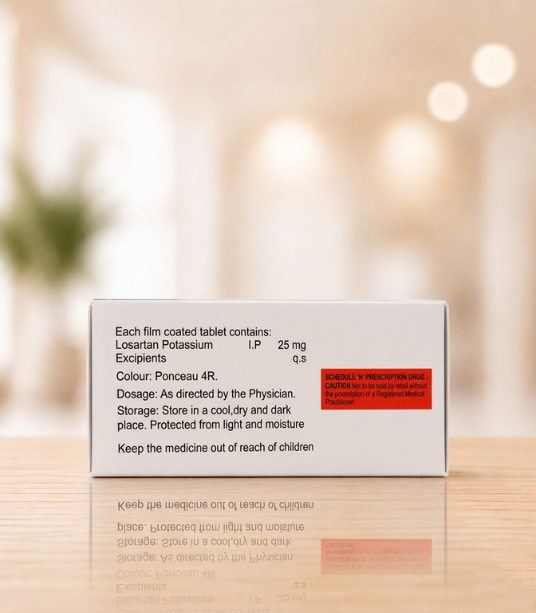



Saltan 25
SALTAN 25 (Losartan Potassium 25mg) is an oral medication belonging to the Angiotensin II Receptor Blocker (ARB) class. It was the first ARB to be FDA-approved and remains one of the most widely prescribed treatments for hypertension (high blood pressure) due to its well-established safety profile and additional protective benefits for the kidneys.
The 25mg strength is considered a low dose, often used as a starting point for specific patient populations or as part of a multi-drug regimen.
1. Mechanism of Action: The Selective Blockade
Losartan targets the Renin-Angiotensin-Aldosterone System (RAAS), which is the body’s primary “thermostat” for blood pressure.
- The Specific Target: It selectively blocks the $AT_1$ receptor.
- Preventing Constriction: A hormone called Angiotensin II normally binds to these receptors to make blood vessels tighten. Losartan sits in the receptor “seat” so the hormone cannot attach.
- The Result: Blood vessels remain dilated (relaxed), which lowers the pressure the heart must exert to circulate blood.
- Uricosuric Effect: Uniquely among ARBs, Losartan has a mild effect on the kidneys that helps increase the excretion of uric acid into the urine, which can be a secondary benefit for patients with high uric acid levels.
2. Clinical Profile of the 25mg Dose
While 50mg is the standard adult starting dose, the 25mg dose is strategically used in several scenarios:
- Elderly Patients: To prevent a sudden drop in blood pressure that could lead to falls.
- Volume-Depleted Patients: For those on high-dose diuretics (water pills) where there is a risk of dehydration-induced kidney stress.
- Hepatic Impairment: Since Losartan is activated by the liver, a lower 25mg starting dose is often recommended for patients with liver issues.
- Renal Protection: In patients with Type 2 Diabetes and hypertension, it is used to slow the progression of diabetic nephropathy (kidney disease).
3. Pharmacokinetics
| Feature | Details |
|---|---|
| Activation | Losartan is a “prodrug.” It is converted by the liver (CYP2C9 and CYP3A4) into an active metabolite (E-3174) that is 10 to 40 times more potent than Losartan itself. |
| Peak Effect | Losartan peaks in 1 hour, but its active metabolite peaks in 3 to 4 hours. |
| Duration | Despite a relatively short half-life, its active metabolite provides blood pressure control for 24 hours. |
| Excretion | It is cleared through both the bile/feces (approx. 60%) and urine (approx. 35%). |
4. Potential Side Effects
Losartan 25mg is generally very well-tolerated. It does not typically cause the “dry cough” associated with ACE inhibitors.
- Dizziness: Most common when first starting the drug as the body adjusts to lower pressure.
- Hyperkalemia: Can cause the body to retain potassium.
- Fatigue: Some patients report feeling tired during the first few weeks.
- Hypotension: Low blood pressure, especially when moving from a sitting to a standing position.
5. Critical Precautions
- Pregnancy (Black Box Warning): Losartan must be stopped immediately if pregnancy is detected. It can cause severe injury or death to the developing fetus during the second and third trimesters.
- Potassium Monitoring: Patients should be cautious with salt substitutes containing potassium and should have their blood levels checked periodically.
- Drug Interactions: Taking Losartan with NSAIDs (like Ibuprofen) can reduce its effectiveness and increase the risk of kidney damage.
- Lithium: Losartan can increase the levels of Lithium in the blood, which can be toxic for patients taking it for mood disorders.
6. Administration Summary
- Consistency: Take at the same time every day, with or without food.
- Monitoring: While 25mg is a low dose, the full effect on blood pressure usually takes 3 to 6 weeks to stabilize.
- Home Tracking: It is often recommended to keep a log of morning blood pressure readings to help your doctor determine if the 25mg dose is sufficient.
Medical Disclaimer: This description is for educational purposes and reflects clinical pharmacology. Always consult your healthcare provider for medical advice and never start or stop a prescription medication without their guidance.